
I wish I hadn’t found the two old books. Their stories upset me and took me to a dark place I really didn’t want to go.
“Civilization is a hopeless race to discover remedies for the evils it produces.”–Jean Jacques Rousseau
I have become a scavenger, constantly looking through the shelves of old shops and flea markets for volumes about the history of my state and The North Country. My world has become smaller during the pandemic. My longest trips are now by car, and they are very close to home. But even with these limitations, there are moments of surprise and wonder. I have finally taken the time to notice old architecture and landmarks. I have also begun exploring secrets that have been carefully hidden from general knowledge in the chapters of local history.
The two old books lay side by side, yellowed and beaten up, on a table in an antique shop. They seemed to beg to be picked up and read: The Proceedings of the Board of Supervisors of Jefferson County, NY, one from 1905 and the other from 1910. They were from my county, and as I looked through them, I found that they listed the industries of each township. I was thrilled to have this information and was willing to pay the price to own them.

The content was fascinating, everyday life written in a multitude of interesting details. But even in the formal reports a human story emerged and it presented itself with as much emotion as any novel. In each book, there was the “Report of County Judge”, a list of over thirty people, each person examined by two doctors, deemed insane, and committed to The St. Lawrence State Hospital in Ogdensburg, NY. Most of the people on the list were sent away because “proofs showed (they) had no property”. This didn’t seem right. Deemed insane because of being poor? I needed to know more.
For me, it’s never been enough to read about a place or an event; I need to experience it firsthand. I need to visit the locations where things have happened, to see the surroundings and the context. I’m not afraid to go to old ruins and graveyards. It’s sightseeing at its rawest. No roped off exhibits with explanations, no narrative signs, no gift shops, no t-shirts or refrigerator magnets to take home to remember the glorious day. The forgotten sites are what they are, the remaining evidence of other moments and other lives.. When I arrived at the asylum in Ogdensburg, New York, it was abandoned, boarded up, and surrounded by a fence.

Not ready to give up, I next went to the New York State history room of my local library, where I found all the volumes of The Proceedings of the Jefferson County Board of Supervisors. Starting in 1911, I examined every volume up to 1964 and found that every year, from 39 to 88 Jefferson County citizens were sent away to places for mental health rehabilitation, mostly because of a lack of property. In 1965, the practice of listing patients’ names and hometowns was discontinued.
I was still puzzled by the fact that poverty had been the undisputed evidence of insanity and the justification for commitment. I read that people from lower socioeconomic backgrounds were often looked down upon by most of society in the late 19th century. Some saw those without property and means as “moral degenerates, victims of subtle vices which undermined our national vitality.” Instead of “systematic changes and rational long-term policies, ideological-driven views and moral prejudices influenced the way to dispose of the poor. It became the practice of the day for a person who wasn’t able to take care of themselves and had no family that could support them to be institutionalized.
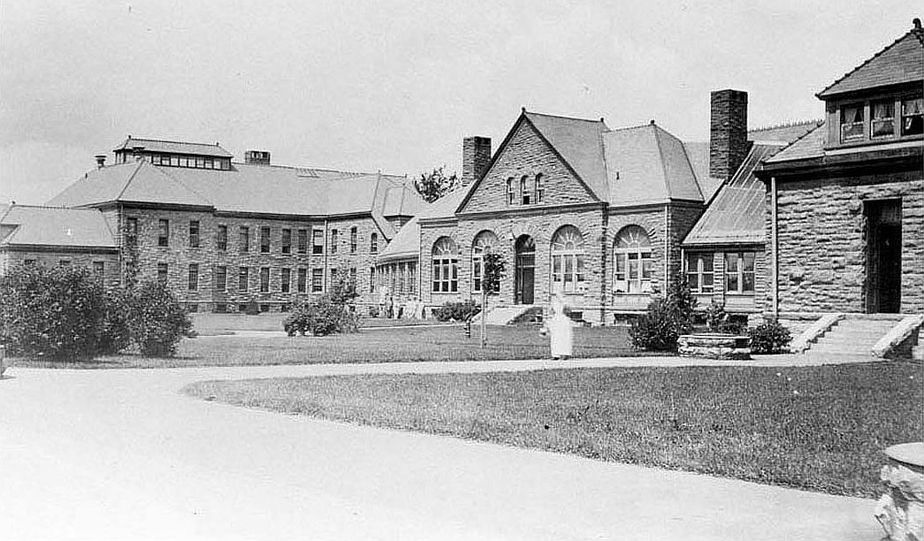
In 1889, Dr. Peter M. Wise became the superintendent and renamed his new charge, The St. Lawrence State Hospital. He believed in the theory of “moral treatment,” which included rest, recreation, and occupational therapy (‘purposeful activity”). A variety of craft-making activities were available, including sewing, chair caning, weaving, and woodworking. The hospital garden, tended by residents, raised enough food and tobacco for all its occupants. Dr. Wise also started an on-site nurse training program.
Asylum care gained strength in the late 1800s. Institutions were established throughout New York State to care for the unfortunate. There was a need for such a place in The North Country, and a group of civic-minded people rallied to find a solution. The construction of the Ogdensburg State Asylum for the Insane began in 1887 on the St. Lawrence River, spanning 958 acres at Point Airy. It was designed according to “The Cottage Plan,” which provided for detached buildings, allowing patients to be grouped by psychiatric disorder.
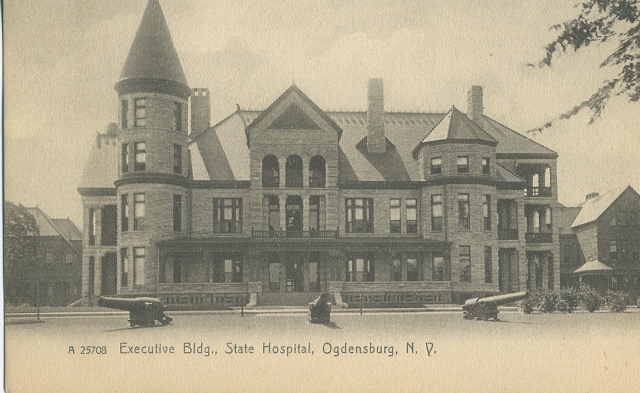
As I reviewed the volumes of the Board of Supervisors reports, I observed the evolution of healthcare in my county. In 1920, a TB center was established. In 1927, public health nurses were deployed to rural areas for maternity and child care services. Smallpox and scarlet fever were monitored. The Association for the Blind was formed. And the placement of patients became more thoughtfully specialized. People were sent to the State School in Rome, US Veterans Hospital in Northport, Long Island, The Marcy Hospital, and The Craig colony for those with epilepsy., The Syracuse Psychiatric Hospital, or The Gowanda Homeopathic Hospital. Treatment evolved as mental health science advanced.
At St. Lawrence State Hospital, voluntary admissions began in 1908, and outpatient treatment commenced in 1910, resulting in a decline in the hospital’s population. In 1955, tranquilizers came on the scene, making patients less aggressive and no longer needing constant supervision. In 1957, an open-door policy was introduced, allowing some patients more freedom to come and go. Unfortunately, in the 1960s, legislation was passed that no longer allowed patients to participate in work projects. In the 1980s, the state hospital was closed, fenced in, and its buildings began deteriorating in the harsh The North Country weather.
The practices from over a hundred years ago upset me, but doing more research, I’ve come to wonder if we’re doing any better with mental health problems now. In my search for answers, I came across a sobering quote about the current state of affairs. “Thousands enter our nation’s mental health system every day, with limited chances of emerging unscathed, or even improved. If hospital stays are considerably shorter, due to aggressive use of medications, limitations imposed by insurance payers, and the availability of more community housing, they are no more marked by recovery and full community integration than in the days of large state hospitals.”
In addition, we as a culture seem to be perpetuating our society’s growing “disease of despair”. Many people in power are motivated by profit, exploiting those who are vulnerable and in need. People without bank accounts often turn to high-cost predatory lending and payday check-cashing schemes. High interest rates on credit cards destroy people who are struggling financially. Despite the prolific and sometimes overuse of pharmaceuticals, we still live in a world of chronically depressed and unhealthy people. Homelessness, crime, childhood poverty, and illegal drug use are on the upswing. The opiate crisis, for example, made a lot of money for some, as it destroyed the souls of individuals, families, and communities. And right now, my state is in the process of legalizing and promoting marijuana use without understanding how weed hurts young minds and without recognizing the full scope of the unintended problems that will arise from this legislation.
Recently, I visited a nationally known chain store and found the staff standing around two new, glitzy New York State scratch-off machines. They were placed in the aisle that ran along the path at the end of the checkout rows, leading to the exit. I live in an area plagued by poverty, made worse now by inflation. I asked the group if they were worried about the adverse effect these machines would have on the disadvantaged and financially desperate. I was told I didn’t have to use gambling machines and that those people who did use them would be okay.

To make matters worse, New York State is allowing online betting starting this year, 2022. Our legislators passed a law in April 2022 allowing this practice. There are now several companies that will feel no guilt as they encourage people to lose money in a scheme where the odds are against them. On my local TV station, such companies blast commercials with the phone number for gambling addiction help at the bottom of the screen. Recently, one of these ads was followed by another ad for a bankrupt attorney. Coincidence?

Have we become insane as a society? Have we become so blind that we don’t understand that not all our problems can be solved with money and technology? In our rapid evolution, have we removed ourselves from basic truths, root causes, and common-sense solutions? Have we forgotten that we are merely humans easily swayed by fear and impulse? How about helping our young people to be productive in this chaotic world? How about more life skills taught in our schools to prevent the ever-growing disease of despair? For example, financial education for all kids should be offered before the dropout age of 16. (A state senator from New York proposed such a program, but it is stuck in the NYS Education Department right now and has gone no further.) How about teaching more life coping strategies? Resiliency training would be of great value, helping pupils understand the importance of goal-setting and how to overcome mistakes and setbacks. https://theautonomoustraveler.com/2018/02/20/resiliency-the-bear-and-the-buckwheat-pillow/
We seem to live in a world working against itself. Many dedicated individuals work tirelessly to help those in need, as well as others who strive to guide people toward creating a healthier world. However, we are allowing counterproductive policies and practices to persist. As a result, in our collective insanity, we have created a cascade of unintended consequences and continuous problems.
I wish I hadn’t found the two old books. Their stories upset me and took me to a dark place I really didn’t want to go.
“Civilization is a hopeless race to discover remedies for the evils it produces.”-Jean Jacques Rousseau.
Copyright@2022 theautonomoustraveler.com All rights reserved.
 The Autonomous Traveler
Your research in response to finding those 2 old books is interesting indeed. Sometimes our readings do not lead us down a primrose path, though, as you have discovered. I wonder if there are any stories that lead in a more positive direction? https://timeline.com/willowbrook-the-institution-that-shocked-a-nation-into-changing-its-laws-c847acb44e0d
Here is a positive story that I personally know about. I have a friend (a former teacher) and her husband who took into their own home a severely mentally disabled young teenage girl a number of years ago. Sarah’s mom was no longer able to take care of her, but did come to visit her periodically and for special occasions. At the time, Sarah was unable to dress herself and only had a very few words. Sarah is now about 21 years old, smiling all the time, can talk, sings alot, dresses herself and has endeared herself to all those who know her. Last year, my friend and her husband were able to adopt her, as her biological mother had less and less to do with her in recent years. Sarah also was able to attend a day school for several hours per day. She can also read a little and do some simple math like counting objects. My friend is a true miracle worker! Everyone loves Sarah!
A second story that I personally know of is about my niece’s husband’s family who have become our extended family. Lucille and Joe had 3 children. Their firstborn child Dawn was born severely mentally and physically handicapped and was put into a very good group home very early on. While she is now 51 years old, she only has the mental capacity of a 2 year-old. Her family visits her often and she is well-dressed and happy, although she still can barely speak. The facility is clean, has activities for residents and treats them well with a high ratio of professionals to clients.
And then I have my own experiences with the mentally handicapped through my own teaching and life experiences. One of them is about Michael, whose parents refused to instutionalize him right from the start on the 1960s. So when I got my first teaching job, there was Michael, a shared student between my other two 5th grade colleagues and me. He had an IQ of about 30-40, but also had savant syndrome and could play any music he heard instantly on the piano, chords and all! (It was rather an uncanny experience! ) He had special education teachers who were amazing and he spent some time “mainstreamed” into social studies, science, etc. with their support. and of course, a different set of expectations. All the other kids in school knew about Michael and loved him! In our class, the reward each day was to have Michael play the piano for us, the school district supplying the piano to one of his grade-level teachers each year for that purpose. The “regular” students received an understanding and empathy for the mentally handicapped that they could carry with them the rest of their lives. Case in point, a few years ago, just after taking my seat on a plane, a down syndrome young man in his early 20’s boarded the plane. In the first row there was an empty seat next to another well-dressed young man also in his 20s. The down syndrome young man asked if he could sit in the empty seat next to the young professional, who responded, “Sure!” A conversation then ensued between them, for nearly the entire 2-hour flight, the young professional treating the down syndrome young man with total respect. It was a reassurance for me that the public school system with inclusion is working in society at large, although I’m sure there are exceptions to this. But at least we are moving in a positive direction.
I know that there are still institutions that are understaffed, underfunded, some still very inadequate,and some outright still bad, but I like to think that the arc bends toward the light.
LikeLiked by 1 person
Thank you, Karen. I know there are many sources of light in our world. I have experienced them as a teacher and I know the loving work of the helpers and volunteers in my community. But in my travels and reading I have witnessed the disregard for some segments of our populations especially the poor and disadvantaged. This attitude has a long history, a history that somehow wasn’t taught to me in school. As I roam my beloved North Country during this pandemic I’ve taken the time to really see. And hopefully I’m living my favorite quote, “The real voyage of discovery consists not in seeking new landscapes but in having new eyes.” I cherish the good in our society but we can always do better. This is my sincere hope. Thank you for your positive input, Karen. I loved these reminders of the compassion that is ever present in our lives.
LikeLike
Joyce, your research is profound on so many aspects from our beloved Northern New York. It is my fervent prayer that from your searching and your writing that you find solace from your turbulent discoveries. It seems to me that during this pandemic there are so many, many events, situations and areas of concern, that if lingered on too long could lead to days of despair. One of them as you so eloquently write about, the rich getting richer and the poor becoming even more down trodden.
Thank you for advocating for your Northern New York community so passionately. The world could use more people like you my friend.
LikeLiked by 1 person
Thanks, Tammy. I always value your input. Traveling around the North Country, shopping for groceries and stopping to get gas, I see so many people standing outside or hunched over in their cars scratching off their new tickets hoping to be lifted from their despair. I notice this more and more as the pandemic wears on. How insane that we would add to their misery by making it so easy to lose money quicker by using their phones or computers. I hope I’m making people aware. I plan on reaching out to some of our lawmakers to encourage them to get the financial education curriculum out of committee and into the light.
LikeLike
Pingback: “SQUIRREL!!!!!!!!” – The Autonomous Traveler